Core Concepts
RepX provides reproducible experiment execution on High-Performance Computing infrastructure. The framework separates experiment definition from execution, enabling portable workflows across heterogeneous compute environments.
Architecture Overview
RepX comprises three distinct layers:
| Layer | Component | Function |
|---|---|---|
| Definition | Nix library | Experiment specification, dependency resolution |
| Execution | Rust CLI | Orchestration, synchronization, job management |
| Analysis | Python library | Result querying, metadata access |
Terminology
Stage
A discrete computational unit with explicit interfaces:
- Inputs: Data dependencies from upstream stages
- Outputs: Produced artifacts consumed by downstream stages
- Parameters: Configuration values affecting execution
- Environment: Software dependencies captured as Nix closures
Pipeline
A directed acyclic graph (DAG) of stages connected by data flow dependencies. Stage outputs map to downstream stage inputs.
Run
A parameterized pipeline instantiation. Multiple runs may share pipeline structure with varying parameter configurations.
Lab
The build artifact produced by nix build. A Lab encapsulates:
- Experiment DAG structure (metadata JSON)
- Job executables and dependency closures
- Container images (when applicable)
- Host tools for target bootstrapping
Workflow
1. Define
Specify experiment structure using the repx Nix library:
{
  outputs = { self, repx, ... }: {
    packages.x86_64-linux.default = repx.lib.runs2Lab [
      # Run definitions
    ];
  };
}
2. Build
Generate the Lab artifact:
nix build
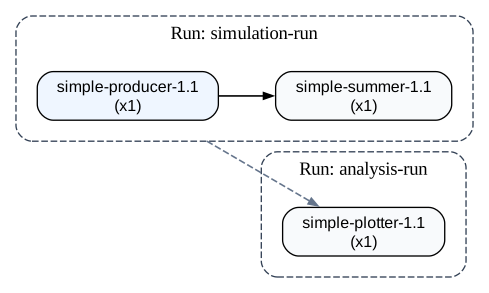
3. Visualize
Inspect experiment topology:
repx viz --format svg
4. Execute
Submit to an execution target:
repx run <run_name> --lab ./result [--target <target>]
5. Analyze
Query results programmatically:
from repx_py import Lab

lab = Lab.from_path("./result")
for job in lab.jobs():
    print(job.outputs)
Execution Model
Scheduling
RepX supports two scheduler backends:
| Scheduler | Use Case |
|---|---|
local | Direct execution with concurrency control |
slurm | HPC cluster submission via SLURM |
Runtime Environments
Jobs execute in isolated environments:
| Runtime | Description |
|---|---|
| Native | Direct process on host system |
| Bwrap | Bubblewrap namespace isolation |
| Docker | Docker container |
| Podman | Podman container |
Incremental Execution
RepX tracks job completion state. Interrupted executions resume from the last completed job. Container images are synchronized incrementally to minimize transfer overhead during iterative development.